Overview
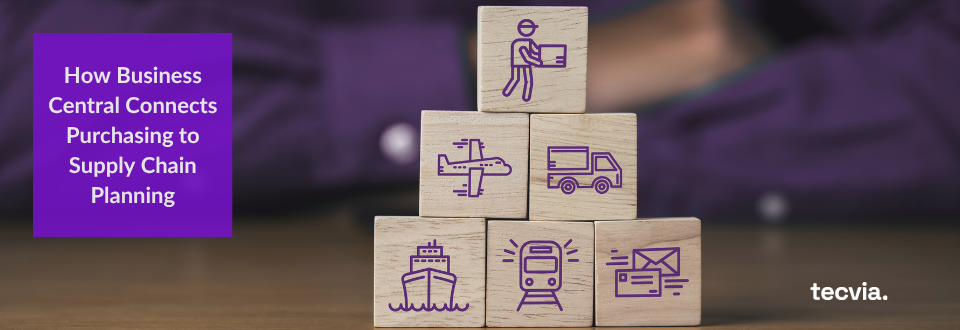
This post explains how Business Central links purchasing decisions directly to supply chain planning in one system.
Most supply chain problems don’t start in the warehouse. They start weeks earlier, when a purchase order goes out late, a supplier quotes the wrong lead time, or a reorder point gets missed. By the time the stock shortage hits, the damage is already done.
The root cause is almost always the same. Purchasing and supply chain planning are treated as separate functions, managed in separate systems, by separate teams. One side of the business doesn’t know what the other is doing until something goes wrong.
Business Central connects your purchasing process directly to supply chain planning. Data flows between them automatically, so your planning is always based on what’s actually happening in your business. Fewer surprises, better decisions, and a supply chain that reacts before problems escalate.
Where Purchasing Meets Supply Chain
Purchasing isn’t just about placing orders. It’s the first link in your supply chain, and one of the core features Business Central is built around.
The decisions you make at the buying stage shape everything that follows. Which suppliers you use, what quantities you order, when you order them, and what you pay all matter. Each of those decisions has a knock-on effect on stock levels, production schedules, delivery performance, and cash flow, which is why our guide for finance directors and managers covers this connection in more depth.
When purchasing runs in isolation, those decisions get made without full context. A buyer places an order based on a spreadsheet that doesn’t reflect current stock. A manager approves a purchase order that exceeds budget because there’s no live visibility into spend.
Business Central removes that isolation. Purchasing, inventory, planning, and finance all sit in one system, so the data is shared and the decisions that follow are better for it.
Supplier Lead Times And Planning
One of the most common causes of stock shortages is inaccurate lead times. If your system thinks a supplier delivers in five days but the reality is ten, your reorder points are wrong from the start.
In Business Central, you set lead times at the supplier and item level. The system uses those lead times when calculating when to reorder, when stock will arrive, and whether you can meet customer demand. It factors them into planning suggestions automatically, so your buyers aren’t doing mental arithmetic to figure out when to place an order.
If a supplier’s lead time changes, you update it once. The planning engine adjusts every calculation that depends on it, and that update ripples through your reorder points, purchase suggestions, and production schedules immediately.
For businesses managing dozens of suppliers and hundreds of SKUs, that automation is what keeps operations teams working from accurate information.
Reorder Points And Safety Stock
Business Central lets you set reorder points and safety stock levels for each item. When stock falls to the reorder point, the system flags it or generates a purchase suggestion automatically, depending on how you’ve configured it.
Safety stock acts as a buffer, accounting for variability in demand and variability in supplier delivery. If a supplier occasionally delivers late, or demand for a product spikes unpredictably, safety stock gives you a margin to absorb that without hitting a stockout.
Getting these settings right takes some analysis. Business Central gives you the historical sales and purchasing data to do it, so you can assess supplier reliability and set levels that reflect reality rather than guesswork.
For businesses in manufacturing or distribution where a stockout has a direct cost, this is one of the most practical things you can set up.
Purchase Order Workflows And Approvals
Before an order goes to a supplier, it needs to go through the right checks.
Without a structured approval process, purchase orders can go out without the right sign-off, and budget limits get breached. Business Central includes approval workflows for purchase orders, so you define the rules based on order value, category, or supplier.
Approvals can be tiered. An order below a certain value might be approved by a team leader, while larger orders require a finance director to sign off, and the workflow handles the routing without manual chasing.
This keeps spending under control without slowing down your procurement team, because the process happens faster and with a full audit trail.
Vendor Performance Tracking
Over time, you need to know which suppliers are reliable and which are not.
A supplier who consistently delivers late, short ships, or sends incorrect documentation creates problems throughout your supply chain. Business Central records delivery performance against purchase orders, so you can see how often deliveries arrive on time and how frequently issues are raised, covered further in our guide to vendor management.
That data matters in several ways. When you’re deciding who to order from, past performance is a more reliable guide than a sales pitch. When you’re negotiating terms, delivery performance gives you something concrete to discuss.
Demand-Driven Purchasing
Business Central’s planning tools look at current stock levels, open sales orders, production requirements, and lead times to calculate what you need to buy and when.
Instead of guessing or relying on spreadsheets, you work from a clear purchase suggestion based on real demand. The system tells you what to order, in what quantity, and by when, based on everything it knows about your inventory position and your suppliers.
You review the suggestions, adjust anything that needs human judgement, and convert them to purchase orders. The whole process is faster, more accurate, and less dependent on individual buyers holding knowledge in their heads.
For manufacturing businesses running to tight production schedules, demand-driven purchasing is what keeps production moving, so components arrive when they’re needed rather than two weeks early or two days late.
Blanket Orders And Long-Term Supply Agreements
Some suppliers work best with long-term agreements. You commit to buying a certain volume over a period of time, and in return you get better pricing, priority allocation, or guaranteed capacity.
Business Central supports blanket purchase orders through the same purchasing configuration covering approvals and lead times. You create the agreement once, set the total quantity and value, and then release individual orders against it as you need stock.
This works well for high-volume, regularly purchased items where you want the commercial benefits of a long-term commitment without losing control of when and how much stock you actually take.
Three-Way Matching
When a supplier invoice arrives, how do you know it’s correct?
Business Central supports three-way matching, comparing the purchase order, the goods receipt, and the supplier invoice. If the quantities or prices don’t align, the system flags it before the invoice gets approved for payment through your financial management workflow.
This catches errors and overcharges before they become a problem. For businesses with high purchase volumes, three-way matching is a meaningful control that reduces both errors and the time spent resolving them.
Who Benefits Most
This matters most for several sectors.
Distribution and wholesale businesses benefit because purchasing volumes are high and margins depend on getting quantities and timing right. Manufacturing and engineering businesses rely on it because purchase decisions feed directly into production planning, and a late delivery stops the line.
Food and beverage businesses need it because short shelf lives and variable demand make accurate reorder timing and supplier reliability critical. Life sciences businesses depend on it too, since purchasing controls and audit trails are part of regulatory compliance, along with medical device businesses working under similar scrutiny.
If your purchasing and supply chain planning are still running separately, our guide to managing obsolete and slow-moving stock shows what happens when the two stay disconnected.
Bring Purchasing And Planning Together
Disconnected purchasing and planning cost you stock shortages, wasted spend, and late deliveries. Tecvia configures Business Central’s purchasing, planning, and approval workflows so both sides of your business work from the same data.
Get in touch for a free consultation, or ask us for a demo of how supply chain planning works in practice. Our support team stays involved after go-live, and our guide to implementation pricing explains what a project typically costs. Contact Tecvia to find out how we can help.