




Built Using Microsoft Dynamics 365 Business Central to Give Food and Beverage Businesses Full Control of Their Operations.
BI (Europe) Limited, the 89-person UK condiment manufacturer behind Harrison Sauces, had outgrown an ERP that could not scale with them. We implemented Business Central across finance, inventory and supply chain, starting with only what the operation needed at the time, then followed it with a two-year development programme as their requirements grew.
“We extensively looked at the market before making any decisions, and Tecvia stood out as a partner that understood where we were currently and where we wanted to get to.”
Priyan K Dhutia, Operations Director, BI (Europe) Limited
Business Central is Microsoft’s cloud ERP for finance, stock, production, purchasing and sales. Food and drink manufacturers need the Premium licence, at £84.60 per user per month, for production orders and recipes. Food distributors and wholesalers usually run on Essentials, at £61.50. See Business Central pricing for the full breakdown.
Best-before dates, allergen declarations, catch weight, and a customer asking for a full trace by Friday afternoon. Most finance systems were never built for any of it, so the gaps get filled with spreadsheets and someone’s memory.
Microsoft Dynamics 365 Business Central, implemented by Tecvia, brings procurement, production, inventory control and quality checks into one system, with real-time visibility across your supply chain.
With sector-specific add-ons such as barcode scanning, EDI, enhanced lot and batch traceability and built-in quality control, Business Central improves accuracy, reduces waste and cuts the rekeying between departments. Lot records are captured as work happens, so the traceability evidence is there when you need it.
Whether you are looking to reduce costs, tighten stock control or respond faster to customer demands, Business Central gives food and drink businesses one version of the numbers to run on.

We implement and support Business Central for UK food and drink businesses, including Belvoir Farm, Harrison Sauces and Moving Mountains. Our team knows the food industry, from traceability and shelf life to customer demands and thin margins, so the conversation starts with how your business actually runs rather than with a demo.
Stock ages quietly until someone spots it. Best-before and FEFO control flags product as it approaches date, so you sell it, discount it or move it before it becomes a write-off.
Paper checks live in folders nobody opens. Inspection checkpoints are recorded against the batch from goods in onwards, so the record is built as the work happens.
Freight, duty and pallet charges land weeks after the stock does. Landed cost pulls them onto the batch, so margin reflects what the product actually cost you.
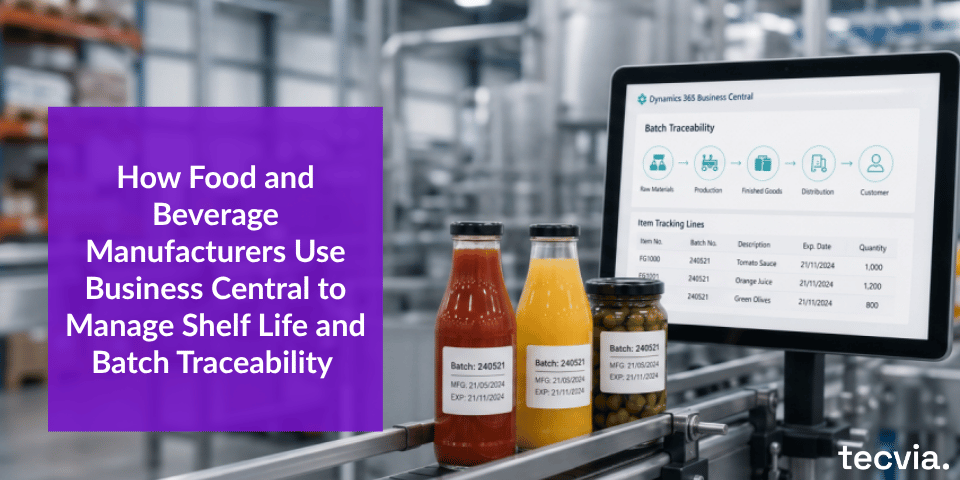
A trace request arrives and the answer sits across three spreadsheets. Lot codes follow product from supplier to customer, so a full forward and backward trace runs in minutes.
Tecvia is a UK Microsoft partner specialising in Dynamics 365 Business Central. We work with food and drink manufacturers, processors and distributors, including Belvoir Farm, Harrison Sauces and Moving Mountains.
Our team knows the food and drink sector, so conversations start with how your business actually runs rather than with a product demo. We handle the implementation, the training and the ongoing support.
The same system your finance team reports from, set up for how food and drink businesses actually run.
See true margin per product line once freight, duty and pallet charges are on the batch. Automate bank reconciliation and month-end so finance is not rebuilding the same spreadsheet every period.
Stock by lot, location and expiry date, with FEFO picking so the nearest-date product moves first. Automated replenishment on ingredients with long or unreliable lead times.
Define inspection checkpoints and record results against each batch, from raw material intake to finished product. Hold or release lots on the result, and see quality performance by supplier and product over time.
Bin-level stock control with barcode scanning at goods in, pick and despatch. Picking routes account for shelf life, so short-dated product is not left at the back of the rack.
Ingredient lead times, alternative vendors and purchase approval workflows in one flow, with goods-in inspections raised automatically on receipt. Track vendor quality, returns and reliance to see which suppliers are actually performing.
Recipes and multi-level BOMs with yield and scrap recorded per run. Shop floor data capture replaces the paper batch sheet, so production is logged as it happens rather than keyed in later.
Yield, waste and margin by batch, product line and customer. Pull traceability and quality records into a report on demand rather than assembling them when someone asks.
Ask questions of your own data in plain English and get an answer back with the records behind it. Copilot also matches bank transactions, maps supplier invoices to purchase orders, and suggests lines on sales documents.
End-to-end visibility across purchasing, production and fulfilment. Set reorder points on ingredients, manage lead times, and see a shortage coming before it stops a production run.
Quotes, orders and customer accounts in the same system as production and stock. Sales can see live availability and shelf life before promising a date, without chasing the warehouse.
Most food and drink businesses looking at a new ERP are weighing up a food-specific system against a general one set up for food. Business Central is the second kind.
A specialist system gives you more out of the box. Business Central gives you a finance, stock and production core that is used across every industry, with the things food needs already in it: lot tracking, best-before dates, landed cost and inspection checkpoints. It is also a lot easier to find people who know it, now and in five years.
Where a process needs more than the standard product, we bring in partners we work with regularly. Yaveon for process manufacturing and quality. Tasklet for barcode scanning and mobile warehouse work. And our own product team, Bee Solved, for the integrations we could not buy off the shelf. All of it runs inside Business Central rather than alongside it, so there is still one system and one set of numbers.
Which one suits you comes down to how specialised your production is. We would rather work that out with you on a call than guess at it here.

Our guide to running a food or drink business on Dynamics 365 Business Central: traceability, shelf life, quality and cost, and what changes when it all sits in one system.
Tell us where to send it and we will email it straight over.
Book a free consultation
Ready to replace spreadsheets and paper batch sheets with one system for your recipes, stock, quality and finance? Our senior consultants will look at how you work today and show you how Business Central would run your food or drink business.
What happens next

Guides and case studies from our team.
The questions we are asked most often by food and drink businesses looking at Business Central.
Dynamics 365 Business Central is Microsoft’s cloud ERP for small and mid-sized businesses. For food and drink companies it runs finance, purchasing, production, stock and sales in one system, with lot and batch tracking built in rather than bolted on. Tecvia implements it for UK manufacturers and distributors.
It removes the gap between the office and the shop floor. Stock, production orders, costs and customer orders sit in one place, so a sales team can see live availability, finance can see true landed cost per batch, and nobody rekeys between systems or works from a spreadsheet that is a day out of date.
Business Central records lot and batch numbers, best-before dates and inspection results against every movement, so you can trace a batch forward to customers and back to raw materials and suppliers. That record is the evidence your own food safety processes rely on. Business Central is a system of record, not a certification, and how it is configured for your standards is part of the implementation.
Yes. Allergen information can be held against ingredients and finished products using item attributes, so it is visible when you build recipes, raise orders and answer customer questions. Add-on apps can extend this to lot level and to allergen-aware production planning. We set this up to match your own allergen controls during the implementation.
Catch weight, where you sell by unit but invoice by actual weight, is handled through add-on apps that Tecvia configures as part of your project. Standard Business Central handles multiple units of measure, so a product can be bought by the case and sold by the kilo.
Yes, through EDI add-on apps. Orders, despatch notes (ASNs), invoices and credit notes can be exchanged electronically with retailers and wholesalers, so orders arrive in Business Central without being rekeyed.
Yes. It handles multiple sites, warehouses, currencies and legal entities, so a single-site producer can move to multi-site without changing platform. Licensing is per user per month, so cost tracks headcount rather than requiring a step change.
Microsoft’s UK list prices are £84.60 per user per month for Premium, which food manufacturers need for production, £61.50 for Essentials, which suits most food distributors, and £6.20 for Team Members who only look things up or approve tasks. Prices are paid yearly and exclude VAT. The implementation is the larger part of the cost and depends on scope: finance and stock alone is a smaller project than finance, production, quality and warehousing together. We scope it before quoting rather than after. See our Business Central pricing page.
It depends on your sites, users, integrations and how much data you bring across. We agree a phased timeline with you at the end of our Inspect stage, so you know your go-live date before configuration starts. See how we run an implementation, or read how Harrison Sauces moved to Business Central.
Yes. Business Central runs in Microsoft’s cloud, with data encrypted in storage and in transit, multi-factor sign-in through Microsoft Entra ID, and role-based permissions that control who can see and change what. Microsoft acts as a GDPR-compliant data processor, and UK customers’ data is held in Microsoft’s UK data centres.
Yes. Microsoft offers a free 30-day trial. We can also run a demonstration using your own products, recipes and processes. Get in touch to arrange one.
For anything not covered here, get in touch directly. We’re happy to answer questions specific to your business and your ERP requirements.
We use cookies to improve your experience on our site. By using our site, you consent to cookies.
Manage your cookie preferences below:
Essential cookies enable basic functions and are necessary for the proper function of the website.
Statistics cookies collect information anonymously. This information helps us understand how visitors use our website.
Google Analytics is a powerful tool that tracks and analyzes website traffic for informed marketing decisions.
Service URL: policies.google.com (opens in a new window)
Clarity is a web analytics service that tracks and reports website traffic.
Service URL: clarity.microsoft.com (opens in a new window)
Marketing cookies are used to follow visitors to websites. The intention is to show ads that are relevant and engaging to the individual user.
LinkedIn Insight is a web analytics service that tracks and reports website traffic.
Service URL: www.linkedin.com (opens in a new window)
You can find more information in our Cookie Policy and Privacy Policy.