Overview
Your ERP should be working for you. If it is not, you are paying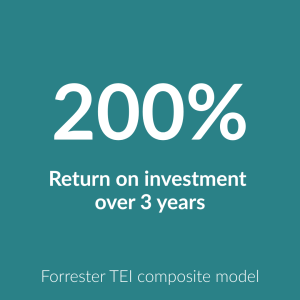 for the gap.
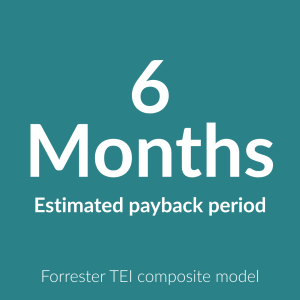
A newly published Forrester Total Economic Impact (TEI) study, commissioned by Microsoft, puts hard numbers on exactly that. The headline finding: more than 200% return on investment over three years, with payback in as little as six months.
That is not a sales claim. It comes from interviews with real business decision makers and Forrester’s own risk-adjusted modelling.
What the Study Looked At
Forrester interviewed four business decision makers who had deployed Business Central, then built a composite model based on a fictitious organisation with £50 million in annual revenue, 300 employees, 15 core finance users, and 100 light users.
The projected three-year benefits for that composite organisation came to more than £680,000 in risk-adjusted present value, with a net present value of around £460,000.
Those are not guarantees. Every business is different, and Forrester’s modelling applies risk adjustments throughout. But the framework gives you a structured way to think about where value actually comes from.
Finance Teams Spend Less Time on the Basics
The biggest single area of projected benefit is finance productivity, valued at more than £210,000 over three years for the composite organisation.

Specifically, the study projects:
Up to 30% reduction in monthly close time
Up to 50% time savings across accounts payable, accounts receivable, and billing
If your finance team is still manually chasing down figures at month end, or reconciling data across multiple systems before they can close the books, that time adds up. Business Central standardises those workflows, which means less time on the mechanics and more time on the analysis that actually informs decisions.
The study also notes that standardised workflows in Business Central create the conditions for AI-assisted processes. Things like Copilot-supported approvals, variance flagging, and exception handling become much easier to adopt when the underlying data is clean and consistent. That benefit was not separately quantified in the study, but it is worth factoring in if you are thinking about where AI fits into your plans.
Lower Cost From Consolidating Systems
Many of the organisations Forrester interviewed were running a combination of ageing on-premises ERP software, spreadsheets, and point solutions bolted together over time. Each of those systems carries its own maintenance cost, licensing cost, and operational overhead.
Consolidating onto Business Central projected a more than 10% reduction in total cost of ownership, with more than £170,000 in present value savings over three years from retiring legacy systems and cutting IT maintenance.
There is also a less obvious benefit here. The more systems you run in parallel, the more people you need to bridge the gaps between them. Fewer systems means fewer workarounds, and a lower risk of things falling through the cracks as you grow.
Better Visibility, Better Margins
One of the harder things to quantify is what better information is actually worth. The Forrester model puts a figure on it.
By year three, the combined organisation was expected to improve net profit margins by up to 3%. This would equal more than £240,000 in present value. That improvement comes from having unified, real-time visibility across finance and operations, which means you can spot problems earlier and act on them faster.
If a project is running over budget, you find out sooner. If a customer account has outstanding balances affecting your cashflow, your team can see it without pulling a report from three different places. That kind of visibility is difficult to replicate when your data is spread across disconnected tools.
Reporting and Audit Preparation
Finance and operations teams often carry a hidden burden of reporting. Board packs, internal management reports, and
 audit preparation all take time, and much of that time is spent pulling data together rather than interpreting it.
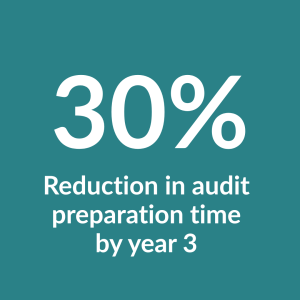
Business Central’s integrated data model, combined with native Power BI capabilities, projected a 30% reduction in audit preparation time and measurable savings in report creation time. Forrester valued those improvements at nearly £50,000 in present value over three years.
That may look modest compared to the other benefit areas, but it reflects real hours saved by real people. And when your data is consistent and auditable by default, it also reduces the risk of errors surfacing at the wrong moment.
The AI Angle
The Forrester study did not try to measure AI-driven results directly. It is important to be clear about that. The value projections are grounded in operational improvements: cleaner processes, unified data, and reduced manual work.
What the study reinforces is that AI tools, including Microsoft Copilot, work better when the underlying data is reliable. Business Central creates that foundation. Clean, integrated data means Copilot can surface useful insights rather than compounding messy inputs.
If you are evaluating Business Central based on its AI roadmap, ask a more immediate question. Will your current systems give those tools useful data to work with?
Is the ROI Case Relevant to Your Business?
The composite organisation in the Forrester model is a £50 million business with 300 employees. If you are significantly smaller or larger, the absolute figures will not translate directly.
What does translate is the structure of the value case. Finance productivity gains, ERP consolidation savings, margin
improvements from better visibility, and reporting efficiency are all real benefit areas regardless of company size. The proportions may shift, but the underlying logic holds.
If you use an older ERP system, consider Business Central. If you rely on spreadsheets to cover gaps, consider Business Central. If you do not have clear visibility into finance and operations, consider Business Central.
You can read the full Forrester Total Economic Impact study at the link at the bottom of this page. It includes detailed methodology and financial modelling.
To talk through what the numbers might look like for your business, get in touch with the team at Tecvia. We offer a free first consultation. We have worked with businesses in manufacturing, food and beverage, distribution, and life sciences.