Overview
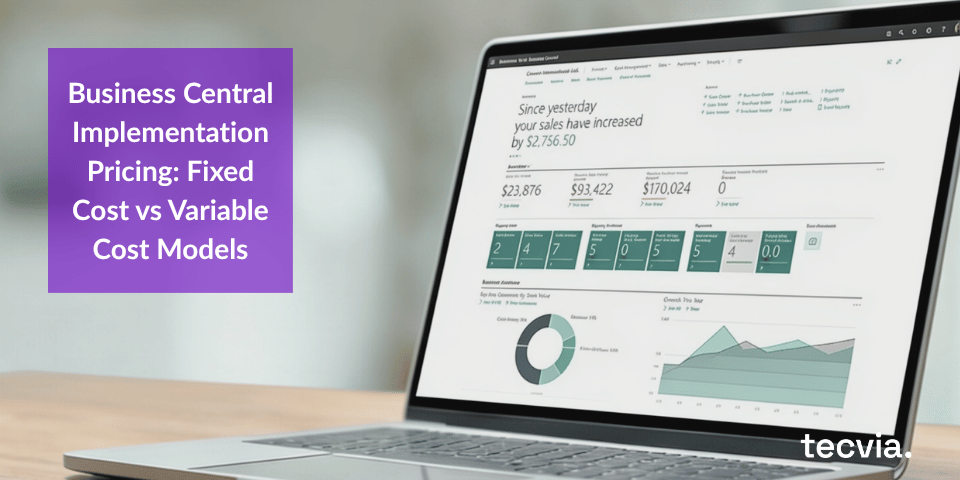
This post covers the two main ways to price a Business Central project: fixed cost and variable cost. It walks through how each model works, sets out the pros and cons, and explains how to pick between them.
What Fixed Cost and Variable Cost Pricing Actually Mean
A fixed cost model sets a single price for an agreed scope of work. Your partner defines the modules, the configuration and the deliverables upfront, then quotes one figure for the whole project.
A variable cost model, often called time and materials, charges for the hours your partner actually works. Costs rise or fall depending on how much configuration, data migration or customisation your business needs.
Neither model suits every business. Your choice depends on how clearly you understand your own requirements before the project starts, and how much change you expect along the way.
The Pros of Fixed Cost Pricing for Business Central
Fixed cost pricing gives you budget certainty from day one. You know the total cost before you sign, which makes internal approval and cash flow planning much easier.
Because the scope is agreed upfront, fixed cost projects also push both sides towards clear documentation. Your partner has to define exactly what is included, so ambiguity gets resolved early rather than during the build.
This model works well when your requirements are stable. A standard finance and inventory rollout across a handful of users, for example, rarely changes much once the modules are chosen.
Panorama Consulting Group’s 2026 ERP Report found that more than a quarter of organisations exceeded their project budgets. Additional technology needs topped the list of causes, and that finding highlights exactly the risk that fixed pricing is designed to contain.
Fixed cost contracts also simplify supplier comparison. When every partner quotes against the same defined scope, you can compare like for like instead of guessing at hourly rates and estimated hours.
The Cons of Fixed Cost Pricing for Business Central
Fixed cost pricing carries a hidden cost of its own. Because your partner takes on the risk of scope creep, they typically build a contingency buffer into the price to cover the unknown.
If your requirements change after the contract is signed, you will likely pay for a formal change request. This can slow the project down, particularly when change requests need internal sign-off before work continues.
Fixed pricing also assumes your business already knows exactly what it needs. When requirements are genuinely unclear, a fixed scope forces decisions too early. You can end up with a system that fits the contract but not the business.
Although the headline number looks appealing, it rarely covers everything. Training, additional integrations and post-go-live support are common exclusions, so read the scope document closely before you commit.
The Pros of Variable Cost Pricing for Business Central
Variable cost pricing gives you flexibility that fixed contracts cannot match. Because you pay for actual hours worked, you can adjust scope as you learn more about your own processes.
This model suits complex or bespoke projects well, such as multi-entity manufacturers with custom workflows across production, warehousing and finance. When requirements are likely to shift, paying for time and materials avoids the cost of constant change requests.
Variable pricing also encourages closer collaboration. Your partner has less incentive to cut corners on discovery. The fee reflects the actual work involved, not a fixed estimate made before anyone understood the detail.
For growing businesses, this model can lower the barrier to starting. You can begin with a smaller phase, review progress, then decide how much further work you need.
The Cons of Variable Cost Pricing for Business Central
The obvious drawback of variable pricing is budget uncertainty. Without a cap, costs can run beyond your original estimate, especially if your team requests changes mid-project.
Research from the Project Management Institute shows that organisations waste an average of 11.4% of every pound invested in projects. Poor performance and weak governance drive most of that waste. Under a variable model, that risk sits mostly with you, so strong project governance matters even more.
Variable contracts also demand more oversight from your side. Someone needs to track hours, review progress against milestones, and question scope drift. Costs can rise before anyone notices.
Because there is no single upfront figure, variable pricing can be harder to sell internally. Finance teams often prefer a fixed number they can approve once, rather than an open-ended commitment.
How to Choose the Right Pricing Model
Start by assessing how well you understand your own requirements. If your processes are documented and stable, fixed cost pricing reduces risk. When they are still evolving, variable pricing gives you room to adapt.
Consider the complexity of your Business Central project too. A standard implementation with core financials and inventory suits fixed pricing well. By contrast, a bespoke build with custom manufacturing workflows or multiple integrations often works better under time and materials.
Many partners, including Tecvia, blend both models. Our related guide explains how Business Central handles project billing across time, materials and fixed fee structures. It shows how the software itself supports either approach. A fixed price for core implementation, paired with time and materials for bespoke add-ons, often balances certainty with flexibility.
Whichever model you choose, ask your partner for a detailed scope document. It should state what is included, what counts as a change request and how those changes get priced.
What This Means for Your Business
Your pricing model shapes how your project runs, not just what it costs. Fixed cost pricing suits businesses with clear, stable requirements and a genuine need for budget certainty.
Variable cost pricing suits businesses that expect their requirements to evolve, particularly manufacturers and distributors running bespoke processes. Because both models carry trade-offs, the right answer depends on your specific project, not a general rule.
Before you sign a contract, ask your partner to walk through both models against your own requirements. A good partner recommends the structure that fits your project, rather than the one that suits them.
For a wider view of what Business Central offers, read our ultimate guide to Business Central before you weigh up pricing.
Get Advice on Pricing Your Business Central Project
Choosing between fixed cost and variable cost pricing affects your budget, your timeline and how much flexibility you keep once the project starts. Tecvia’s team can walk you through both models against your specific requirements and recommend the right fit.
Visit our Business Central implementation page to see how our IDEA approach structures projects, or get in touch with Tecvia to discuss your pricing options.