Overview
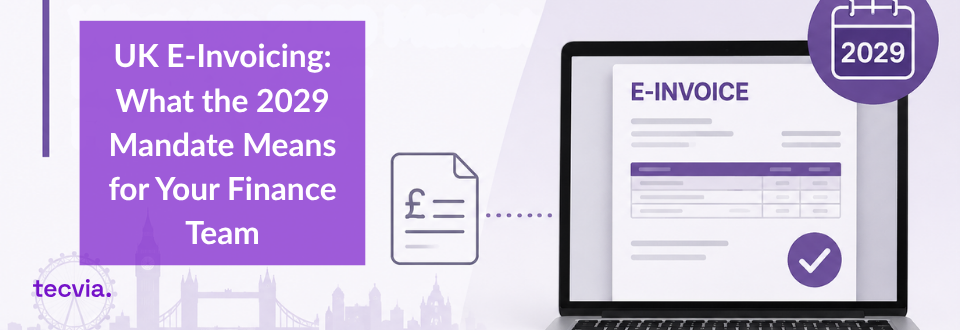
This post explains what UK finance teams need to know about the mandatory e-invoicing rules arriving in April 2029. It covers what HMRC has confirmed so far, what remains open ahead of Budget 2026, and practical steps you can take now.
What Is Actually Changing
Most UK businesses currently send invoices as PDFs or paper documents. A person, or an OCR tool, then reads that document and enters the data into an accounting system by hand.
Under the new mandate, that process changes for VAT invoicing. Structured invoice data will move directly between finance systems, without a document in between. Because of this, PDFs, Word files, scanned images and OCR-derived files will not count as e-invoices under HMRC’s definition.
This distinction matters for finance teams. A PDF invoice may look correct to a human reader, but it will not satisfy the mandate. The requirement is about structured data, which machines can read and process automatically. Dynamics 365 Business Central already manages many day-to-day finance processes, which makes it a natural fit for structured invoicing.
What HMRC Has Confirmed So Far
Several details are now settled. Mandatory e-invoicing applies from 1 April 2029 to VAT invoices. It covers business-to-business and business-to-government transactions, so consumer invoicing sits outside the scope.
In June 2026, HMRC confirmed that Peppol will be the interoperability network behind the mandate. The approach uses a decentralised four-corner model. This means businesses keep their own software or service providers, rather than routing invoices through a single government platform. Belgium and Australia already use a similar structure.
There is no real-time reporting requirement attached to the 2029 mandate. HMRC has said it may explore digital reporting later, once the e-invoicing infrastructure is in place, but this sits outside the current plan.
The expected standard is a UK version of the Peppol International Invoice, sometimes called PINT UK. It builds on EN 16931, the standard already used across much of Europe. A dedicated OpenPeppol UK Working Group is developing the detailed specification now. The requirement applies across manufacturing, distribution and other industries we support, regardless of size.
What Remains Open ahead of Budget 2026
HMRC plans to publish a full implementation roadmap at Budget 2026 in November. This roadmap should cover the finalised technical standards and mandatory data fields.
It should also confirm how service providers become accredited UK Peppol Access Points. Whether the rollout is phased, for example starting with larger businesses first, remains unclear. The treatment of overseas suppliers and legacy EDI systems, common in distribution and wholesale operations, is also still under discussion.
As there is so much detail sits ahead of Budget 2026, finance teams are working from a confirmed direction rather than a finished specification. That is normal at this stage of a mandate. It does mean, however, that planning should happen in stages rather than waiting for every detail to land at once.
Why Finance Teams Should Not Wait for the Detail
It is tempting to treat 2029 as far enough away to leave until the technical detail is confirmed. Two factors argue against that approach.
Many finance teams have not yet had direct guidance from HMRC on what to expect. Waiting for a prompt that may not arrive in time carries its own risk.
The practical preparation window is also shorter than the 2029 date suggests. Moving from document-based invoicing to structured data usually touches your ERP system. It also affects your accounts payable and receivable workflows. Supplier and customer onboarding processes tend to change too, particularly when several trading partners are involved.
How to Start Preparing with Business Central
You do not need the Budget 2026 roadmap to make progress now. A good starting point is mapping your current invoicing setup, including formats, volumes and the systems involved.
Talk to your ERP provider about their Peppol plans. If you already run Business Central finance management, ask whether structured e-invoicing support is available now or planned for other markets.
Check whether you have existing Peppol exposure. Businesses trading with customers in Belgium, France, Germany or the Nordics, or supplying the NHS, may already have access points in place. These can often be extended rather than rebuilt.
Flag legacy systems early, especially bespoke EDI arrangements. HMRC has acknowledged this area still needs work, particularly for manufacturing and engineering businesses running older integrations. Building internal awareness now also avoids a scramble closer to 2029.
For further reading, our post on CoPilot AI and e-invoice matching in Business Central covers a related automation already available today. We have also written about the role of an ERP specialist for businesses planning a wider systems review.
Talk to Tecvia about Your E-Invoicing Readiness
The shape of the 2029 mandate is clear, even though some detail is still to come. Business Central can support structured invoicing as the requirements firm up, but the right configuration depends on your current systems and processes.
Tecvia works with UK businesses running Business Central to prepare for compliance changes like this one. Contact Tecvia to arrange a consultation, or book a demo to see how Business Central handles structured invoicing today.