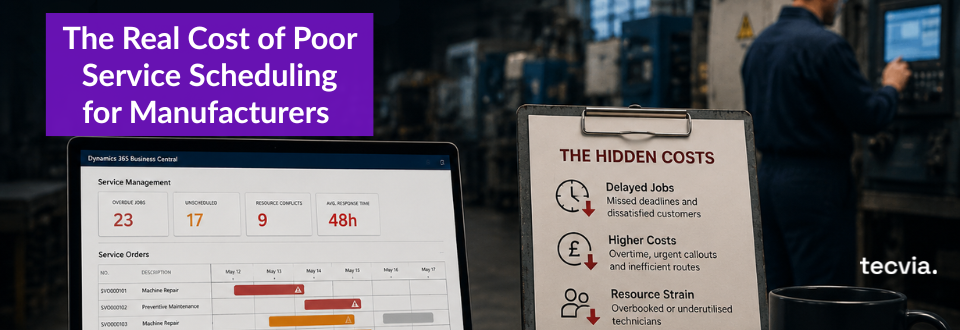
Overview
This blog post explains why poor service scheduling costs manufacturers more than they realise. It covers the hidden costs of missed appointments, wasted engineer time, and disconnected systems. You will also find a practical look at how integrated scheduling solves these problems.
What Poor Service Scheduling Actually Costs
A missed engineer appointment looks like a small problem on the day it happens. Over a year, though, these small problems add up to lost revenue, damaged contracts, and frustrated customers. Manufacturers running service operations on spreadsheets or whiteboards often underestimate how much this costs.
Engineers without clear schedules waste hours travelling to the wrong site or arriving without the right parts. So a single visit can turn into two or three, multiplying labour and travel costs. Field service businesses can lose a significant share of technician time to scheduling inefficiencies each week.
Why Scheduling Breaks Down on the Shop Floor and in the Field
Many manufacturers grow their service operations faster than their systems. A spreadsheet that worked for ten jobs a week struggles when that number reaches fifty. Although the team adds more people, the scheduling process stays the same.
This creates a gap between what dispatchers know and what is actually happening on site. Engineers update job status by phone or text, which means information arrives late or not at all. Because nobody has real-time visibility, double bookings and missed jobs become routine rather than rare.
Parts availability adds another layer of risk. An engineer arrives on site only to find the part they need is back at the depot. The job gets rebooked, the customer waits longer, and the engineer’s day is wasted.
These issues often mirror common implementation mistakes seen across ERP projects generally, not just service scheduling. Skipping proper configuration at the start makes every later process harder to fix. Getting scheduling right from day one avoids costly rework further down the line.
The Hidden Costs Behind a Missed Appointment
A missed or delayed appointment carries costs that rarely show up on a single invoice. First-time fix rates drop when engineers cannot prepare properly for a job. When a fix takes two visits instead of one, the cost of that job roughly doubles.
Contract margins suffer in similar ways. Service level agreements often include penalties for late response, which means poor scheduling directly reduces the profit on a contract. Over a year, those penalties can outweigh the margin the contract was meant to deliver.
Customer relationships take the biggest hit. A manufacturer that misses appointments repeatedly risks losing the contract at renewal, which means losing recurring revenue that took years to build. So the true cost of poor scheduling includes future business, not just today’s wasted hours.
Signs Your Service Scheduling Process Is Failing
Certain patterns repeat across manufacturers struggling with scheduling. Engineers regularly call the office to ask what job comes next, because the schedule sits in someone’s head rather than in a system. Customers chase for updates, because nobody can confirm an arrival time with any confidence.
Spreadsheets multiply across different teams. Nobody fully trusts any of them. Recognising these patterns early prevents them from becoming permanent. They rarely improve on their own, because the underlying process has not changed, only the size of the problem.
Parts shortages on site, repeat visits for the same fault, and engineers finishing later than planned are all measurable signs worth tracking. So is a rising number of customer complaints about communication rather than the actual repair.
How Integrated Service Scheduling Fixes the Problem
Service management in Business Central brings scheduling, job costing, and parts inventory into one system. Dispatchers can assign engineers based on skill, certification, and real-time availability rather than guesswork. This improves first-time fix rates because the right engineer turns up with the right information.
Preventive maintenance schedules shift service teams away from reactive repairs. Because Business Central can trigger maintenance based on time or usage, engineers visit before equipment fails rather than after. This reduces emergency callouts, which are the most expensive and disruptive type of job.
Mobile access means engineers see job details, service history, and parts availability directly from site. When something changes, the system updates in real time. So dispatchers always know what is actually happening. Job costing then tracks labour, parts, and expenses against each order, giving an accurate picture of contract profitability.
Tecvia builds this configuration into a wider Business Central implementation, so scheduling improvements arrive alongside finance, inventory, and production setup. This means engineers, dispatchers, and finance teams work from the same data from day one.
Why This Matters for Manufacturers Specifically
Manufacturing and engineering businesses often run service alongside production, warranty work, and spare parts supply. These activities pull from the same inventory and the same engineers. So poor coordination between departments makes scheduling problems worse. A part allocated to a production order cannot also serve a service job.
This is why project cost overruns and service scheduling problems tend to appear together. Both stem from the same root cause, which is a lack of real-time data connecting the office to the work being done. Manufacturers that fix one of these problems usually find the other easier to solve too.
Equipment downtime adds further pressure. Predictive maintenance approaches discussed in our piece on Business Central for manufacturing show how connecting service data to production schedules reduces unplanned downtime. When service and production share the same system, both sides benefit from better visibility.
An experienced ERP consultant configures scheduling rules around how your engineers actually work, rather than forcing a generic process onto the business. This matters because manufacturing operations rarely match an out-of-the-box setup exactly. Getting that configuration right is what makes the difference between a system that helps and one that gets ignored.
Measuring the Return on Better Scheduling
Independent research backs up what better scheduling delivers in practice. A Forrester Total Economic Impact study found that standardising workflows in Business Central produced significant finance productivity gains. Forrester valued those gains at more than £210,000 over three years for a composite organisation.
Service scheduling sits within those standardised workflows. So similar gains apply to engineer time and contract margin.
Visibility plays a large part in that return. Real-time production reporting through Power BI lets managers see job status, parts consumption, and engineer utilisation as they happen rather than at month end. This turns scheduling from a guessing game into a process you can measure and improve.
The full set of Business Central features connects this reporting layer directly to service, finance, and production data. So a single dashboard can show whether scheduling problems are actually costing the business money, rather than just feeling like they are.
Get Started With Better Service Scheduling
If missed appointments and margin erosion are familiar problems, Tecvia can show you how Business Central solves them. Get in touch with Tecvia to arrange a consultation or a demo of the service management module. Our consultants can review your current scheduling process and identify where the biggest gains are available.
Ongoing support after go-live keeps that scheduling setup tuned as your service team grows. So improvements continue well beyond the initial project.