Overview
This post looks at what happens when warehouse and finance systems run separately, and why that gap costs SMEs more than they realise. It covers the operational and financial impact of manual processes and spreadsheets. It also shows what changes when both functions run on one connected platform.
The Problems with Systems That Don’t Talk
If you run a distribution or wholesale business, your warehouse and finance teams rely on the same data every day. Stock levels, purchase orders, sales orders and invoices are all connected. But in many SMEs, the systems managing that data are still separate.
You might have a standalone warehouse management system, an older finance platform, and spreadsheets bridging the gap between them. At first, this feels manageable. Over time, the cracks show.
When your warehouse and finance systems don’t communicate, your team becomes the link between them. They re-enter data, check figures twice, and fix mistakes after the fact.
Here’s what that looks like in practice. Stock gets updated in the warehouse but not reflected in finance. Finance then raises an invoice based on outdated information, so the order doesn’t match what was actually shipped. Someone has to sort it out manually.
Multiply that across dozens or hundreds of orders each week, and it stops being just frustrating. It becomes expensive.
Manual Processes Create Errors
Every time someone keys data into a second system, there’s a risk of error. A wrong quantity, a missed decimal, or an outdated stock figure can slip through unnoticed.
Those small mistakes lead to bigger problems, such as incorrect invoices sent to customers, stock discrepancies that take time to reconcile, and delayed orders that frustrate customers.
The worst part is that most of these mistakes are preventable. They happen because the systems don’t share data, not because your team isn’t doing its job. Businesses carrying obsolete or slow-moving stock often find these errors compound the problem further.
Spreadsheets Hide the Problem
Spreadsheets often feel like a practical fix. They bridge the gap between systems without a big investment, but they create their own problems.
There’s no real-time updates, no single version of the truth, and a high risk of human error. As order volumes grow, spreadsheets become harder to manage.
One wrong formula throws off your entire report. One missed update leads to incorrect stock figures. Spreadsheets don’t solve the underlying issue, they just delay it until it gets worse.
No Real-Time Visibility Means You’re Always Behind
In distribution, timing is everything. You need to know what stock you have right now, what’s been sold, what needs reordering, and what has already been invoiced.
If your systems don’t sync, you’re working on yesterday’s numbers. You might think you have 1,000 units available, but in reality, you have 850. That gap leads to overselling, backorders, and complaints.
Once a customer loses confidence in your ability to fulfil orders accurately, it’s hard to win that trust back.
Your Finance Team Ends Up Firefighting
Disconnected systems don’t just create operational problems. They hit your finance team hard too.
Instead of focusing on reporting, forecasting, or planning, your finance team spends time reconciling stock and financial records, correcting invoices that don’t match shipments, chasing missing data from the warehouse, and explaining why month-end figures don’t add up.
When the data can’t be trusted, decision-making slows down. Month-end becomes stressful, reports take longer, and confidence in the numbers drops across the business.
What a Connected System Actually Looks Like
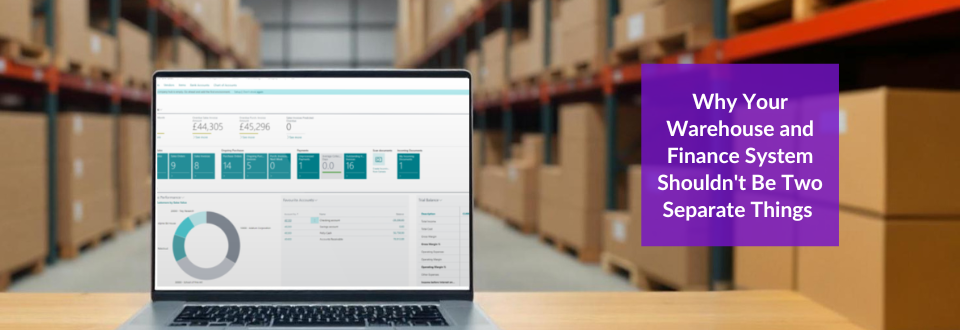
Microsoft Dynamics 365 Business Central brings warehouse management, inventory control, finance, sales, and purchasing into one system. There’s no syncing between platforms because everything runs in the same place. Tecvia’s implementation process is built specifically to bring these functions together from day one.
Here’s what changes when your warehouse and finance share a single system.
Stock updates happen in real time. When goods are received, picked, or shipped, the system updates immediately, so finance sees it straight away. There are no delays, no manual updates, and no mismatches.
Data gets entered once. Orders, invoices, and stock movements flow through the system automatically. There’s no re-entry of data between departments, which removes a significant source of errors and admin time. Some of this automation now runs on built-in AI capability, flagging anomalies before they reach your reports.
Invoices match what actually shipped. Because warehouse and finance data are connected, invoices are generated from the same source as your pick and despatch records. Stock values stay accurate, and reports reflect reality.
Warehouse processes stay guided and traceable. Business Central includes directed pick and put-away workflows, bin-level stock tracking, barcode scanning via handheld devices, and full lot and serial number traceability. Your warehouse team gets clear instructions, and your operations team gets a full audit trail.
You can make decisions with confidence. With accurate, real-time data across both warehouse and finance, Power BI dashboards let you plan stock more effectively, manage cash flow with confidence, and spot issues before they become problems.
A Quick Comparison
Running separate systems means data gets entered multiple times across different platforms, which leads to frequent errors from manual re-entry. Stock and finance figures don’t match, month-end processes slow down, and your team spends time fixing problems instead of running the business.
Running Business Central means data gets entered once and shared across the whole system. Warehouse movements update finance automatically, so stock values stay accurate and financial reports stay reliable. Orders process faster, fulfilment errors drop, and your team works from one place with no gaps between departments.
Why This Matters More For SMEs
You don’t need to be a large enterprise to feel the impact of disconnected systems. SMEs in distribution and wholesale often feel it more sharply, because smaller teams mean less time to fix issues.
Tighter margins mean errors cost more, and growth puts pressure on systems that were already stretched. A connected system like Business Central helps you do more with the same team, reduce the operational friction that slows you down, and scale without adding complexity. This friction is not unique to distribution either, as manufacturers face similar scheduling and service costs when systems don’t talk to each other.
Signs It’s Time To Act
If any of these sound familiar, your current setup is likely holding you back. You rely heavily on spreadsheets to bridge your systems, and your warehouse and finance figures regularly don’t match.
Your team spends time correcting errors rather than processing orders, and month-end reporting takes far longer than it should. You can’t get a clear picture of stock levels and financials at the same time.
These aren’t just admin problems. They’re signs your business has outgrown the tools it started with, whether that’s spreadsheets, basic accounting software, or a system like Xero stretched beyond its limits.
Get In Touch
Tecvia implements Microsoft Dynamics 365 Business Central for distribution and wholesale businesses across the UK. We connect your warehouse, inventory, finance, and purchasing into one system, and we manage the transition from whatever you’re running now.
If you’d like to see how it works in practice, speak to the team at Tecvia or book a free consultation. You can also review pricing options before you get in touch.